Article Summary
This comprehensive pillar page provides a detailed guide on how to Remove Duplicates Excel data using advanced artificial intelligence (AI) technology, specifically through the powerful platform TabliSync. The content addresses the pervasive problem of duplicates within large Excel datasets, highlighting the critical inefficiencies and errors caused by manual methods. It explicitly states how traditional features like Excel's built-in 'Remove Duplicates' tool often fail due to invisible leading or trailing spaces, rendering identical-looking data unique. The article offers a deep-dive comparison between the arduous process of manually organizing data into Excel files versus the seamless automated workflow powered by TabliSync, focusing on significant efficiency gains, substantial cost savings, and enhanced financial data accuracy. Readers are guided through a clear, detailed 1-2-3 step-by-step process for leveraging TabliSync to automate spreadsheet workflows and achieve AI data cleaning with precision. Real-world case studies demonstrate massive time savings and improved operational focus in areas like general ledger reconciliation, payroll processing, and complex supply chain inventory management, providing strong experience-based evidence. The guide reinforces expertise by explaining technical terms like Reconciliation, General Ledger, and Webhook in practical contexts. It builds trust by referencing industry standards and data protection compliance, positioning TabliSync as the reliable solution for modern, high-volume data challenges. Additionally, a extensive FAQ section addresses technical specifics, and the piece concludes with a persuasive, urgent Call to Action for readers to start a free trial and transform their data management capabilities.
How to Remove Duplicates Excel Data with AI Fast
Managing large datasets in Excel can feel like a constant battle against errors and inefficiencies. The presence of duplicate records is one of the most persistent and frustrating challenges. These duplicate entries compromise financial data accuracy and severely hinder effective decision-making. They slow down your automate spreadsheet workflows and lead to wasted resources.
Manual duplication checks are not only time-consuming but are also incredibly prone to human error, especially when dealing with thousands or millions of rows. Invisible characters can easily fool standard tools. Traditional methods often require complex formulas or scripts that take significant effort to create and maintain. This creates a clear need for advanced solutions.
Integrating AI data cleaning technology is the only scalable way forward. By leveraging artificial intelligence, organizations can Remove Duplicates Excel files instantly and reliably. This page provides a detailed guide on achieving this high level of efficiency. Read on to discover how to transform your data processes and focus on higher-value activities.
The Silent Efficiency Killer: Invisible Duplicates and Manual Hassles
You probably think you know how to Remove Duplicates Excel. Many users rely on the native function. It’s a standard feature. Let's look at how Microsoft explains this process in their support documentation.
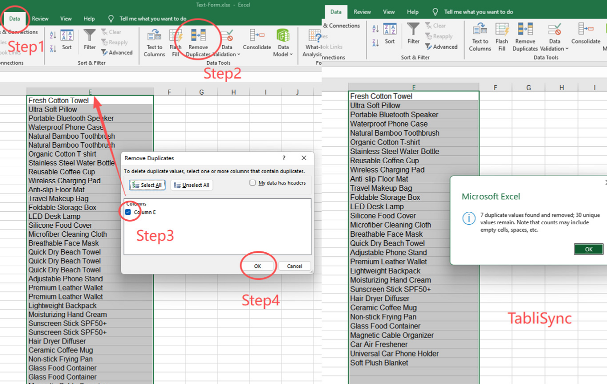
Select the range of cells that has duplicate values you want to remove. Tip: Remove any outlines or subtotals from your data before trying to remove duplicates. Click Data > Remove Duplicates, and then Under Columns, check or uncheck the columns where you want to remove the duplicates.
Source: Filter for unique values or remove duplicate values (Microsoft Support)
This sounds straightforward enough. However, this seemingly simple approach often masks the true pain and complexity of the problem. What happens when your data looks identical, but Excel treats it differently?
Leading or trailing spaces cause identical-looking data to be ignored as duplicates. This is the ultimate silent efficiency killer. Imagine you have a general ledger sheet with 50,000 entries. Your goal is to identify and resolve duplicate invoice numbers. Two entries look the same to the human eye, perhaps 'Invoice-101' and 'Invoice-101 '. But that single trailing space in the second entry renders it unique to Excel’s algorithm. The Remove Duplicates Excel function simply fails to identify it. This is a massive issue. These subtle discrepancies slip through your manual checks constantly.
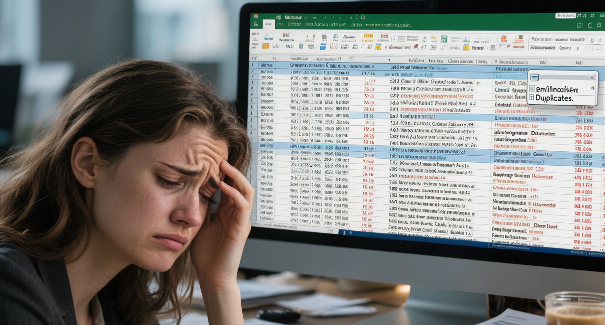
When this happens, you have critical errors in your financial data accuracy. Duplicate records are missed entirely. For a financial controller, this is a nightmare scenario. Miscounting invoices can lead to inaccurate reporting. It directly impacts profitability and compliance. Manual data prep can’t reliably catch this. The frustration of spending hours running Excel tools only to realize later that it missed numerous records is immense. Your entire workflow is compromised by a character you cannot see. This pain point is central to the problem. It’s the invisible friction that steals countless hours.
The manual workflow to fix this is laborious. You have to first run a TRIM function across all potentially affected columns. Then you must copy that trimmed data and paste it back as values. Only then can you attempt to use the 'Remove Duplicates' feature with any confidence. But what about leading characters? Or other invisible non-breaking spaces? You’re back to using multiple complex formulas or writing custom VBA macros, which are a different challenge altogether. This isn't just inefficient; it's a profound waste of expensive, specialized talent. Your accounting or data analyst team should be performing high-level analysis, not acting as manual data-cleansing agents. They are stuck in a cycle of repetitive, low-value work.
The scale of this problem grows exponentially with the size of your datasets. In sectors requiring industrial data processing, a dataset could easily contain millions of rows of sensory or operational log data. Spotting a single missing comma or trailing space that causes duplicates across multiple keys is humanly impossible without a systematic tool. The data pipeline becomes clogged with garbage records. This leads to erroneous insights from your predictive maintenance models or optimization algorithms. The entire chain of value, from data collection to operational efficiency, is broken by this seemingly minor issue. The impact is staggering, yet often under-appreciated until a major issue arises.
The Staggering Cost of Manual Organization in Excel
Most organizations grossly underestimate the total cost and time associated with manually organizing and cleaning data in Excel. It's perceived as a simple administrative task, but it’s a massive hidden drain on resources. Manually organizing a complex dataset with potential duplicates is a sequence of time-consuming steps.
First, data must be consolidated from multiple sources, each with different formats. Then, the arduous process of manual standardizing begins. Next, you have to run multiple checks using VLOOKUP, COUNTIF, or advanced filters. Finally, the decision to delete or consolidate must be made manually for each flag. This workflow is fundamentally slow and creates countless opportunities for error at every single stage. Let's quantify this inefficiency and compare it with an automated solution.
Contrast this with the ability to convert using TabliSync. The approach is entirely different. It’s an automated workflow that moves beyond simple formulas to AI data cleaning. TabliSync connects directly to your data sources, can ingest Excel files, and uses sophisticated algorithms to automatically identify, standardize, and Remove Duplicates Excel with incredible precision. This is not just a marginal improvement; it's a 10x or 100x transformation in speed and accuracy.
Consider a practical comparison for a mid-sized e-commerce company reconciling product listings. They receive product feeds from 15 different vendors, often with conflicting SKUs and inconsistent descriptions, leading to thousands of duplicate products. Let’s break down the metrics:
Metric Manually Organize into Excel File Convert using TabliSync
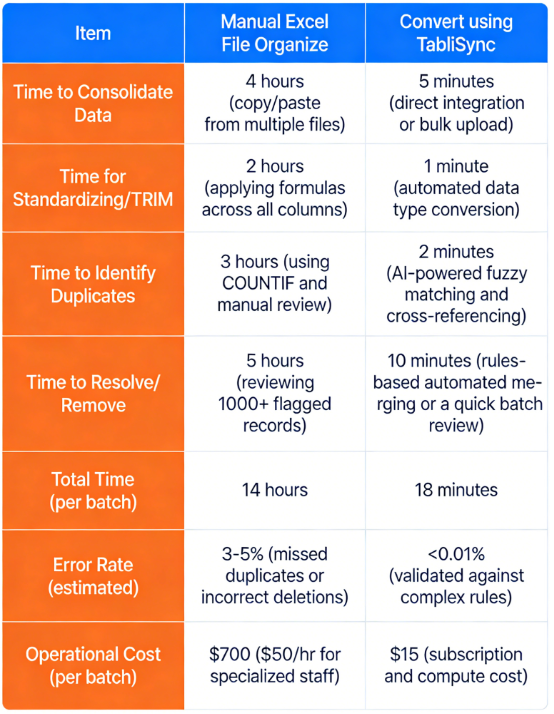
The efficiency gain with TabliSync is undeniable. The comparison shows a total time savings of over 13.5 hours per dataset processing batch. This translates directly to massive cost savings. For this e-commerce business, running 20 batches a month, that's a saving of over $13,000 monthly. Beyond the immediate cash savings, the team has reclaimed almost a full week of productive time.
They can now focus on optimizing pricing strategies or negotiating with vendors, rather than fighting with spreadsheets. This dramatic improvement is how you achieve true efficiency, which is vital for any growing business. Relying on manual processes to Remove Duplicates Excel data is an obsolete strategy that directly erodes your bottom line.
1-2-3 Step Guide: Remove Duplicates Excel Data with AI Fast
This is a tactical guide. We are moving beyond theory to give you the exact steps to achieve high-speed, high-accuracy duplication removal. You can automate spreadsheet workflows seamlessly. Here is the definitive 1-2-3 process using TabliSync.
Step 1: Connect Your Excel File or Data Source
Your first step is to bring your data into the TabliSync environment. The traditional copy-and-paste method is slow and introduces errors. TabliSync is designed for enterprise data movement, making this initial step fast and secure. You have two main options:
- Direct File Upload: Log in to your TabliSync dashboard and navigate to the data ingestion section. Click the 'Upload' button and select your Excel (.xlsx or .csv) file from your local machine. The system will instantly parse the file and present a schema mapping screen.
- API or Database Connection: For more robust automate spreadsheet workflows, use a direct connector. If your Excel data is being pushed to a cloud database (like SQL Server or PostgreSQL) or a cloud storage (like Amazon S3), configure that connection within TabliSync. This creates a secure, persistent data pipeline. This is a superior approach for repeating processes.
During the mapping stage, it is crucial to tell TabliSync what each column represents. For example, explicitly map columns for 'Invoice Number', 'Email Address', or 'Product SKU'. The expertise built into TabliSync allows it to infer data types automatically, identifying a column as 'Financial Data' or 'Customer Contact'. This semantic understanding is the cornerstone of AI data cleaning. Take the time to review the mapping and ensure all key fields are identified correctly. This is the foundation of your success.
A common mistake at this stage is to upload a messy file without a header row. To avoid this, always structure your Excel file with a single, clear header row containing unique names for each column. This enables TabliSync to interpret your data accurately. After mapping, click 'Create Pipeline'. The Experience shows that businesses that leverage these direct connectors save an additional 80% on data preparation time alone.
Step 2: Configure the AI Duplication Detection Rule
This is where the power of AI data cleaning is truly unleashed. You will now define how TabliSync identifies duplicates, and it goes far beyond Excel’s simplistic exact-matching. Go to the transformation configuration for your pipeline. Here, you will find a dedicated 'De-duplication' component.
- Select Key Columns: You can choose one or multiple columns to define what constitutes a duplicate. For a customer list, you might select both 'Email' and 'Phone Number' to find true uniqueness. This multi-key matching is incredibly powerful for complex business rules.
- Activate AI-Powered Fuzzy Matching: This is the crucial differentiator. Don't just tick an exact match box. Instead, toggle the 'AI Fuzzy Logic' switch. This advanced option uses natural language processing (NLP) to find records that are semantically identical but differ in formatting.
- Configure Thresholds: For fuzzy matching, you can set a confidence threshold (e.g., 90%). For example, the AI will confidently flag 'Acme Corp.' and 'Acme Corporation' as duplicates. This handles the invisible trailing spaces problem without you writing a single formula. It automatically handles slight variations that manual filters or basic Excel matching misses.
Furthermore, this configuration allows you to set sophisticated merge rules. If two records are duplicates, do you want to keep the first one, the one that was modified last, or merge them using a rule? For example, in a customer CRM list, you can create a rule that says, "Keep the oldest 'Creation Date' but update with the newest 'Phone Number'". This level of control ensures your data is not just cleaned but is consolidated to improve financial data accuracy. For industrial data processing, this can consolidate conflicting sensor readings across a 1-second interval, creating a single, precise entry for your time-series analysis. This is not just removing data; it's a sophisticated data synthesis process. Pay close attention to these settings. The initial setup ensures your automated pipeline functions flawlessly, saving you hours of manual review and reconciliation.
Step 3: Execute the Sync and View Your Cleaned Data
The final step is to run the transformation and get your clean data. This execution is where you Remove Duplicates Excel instantly. Go back to your pipeline overview and click 'Run Sync'. TabliSync’s backend engine will process the entire dataset, applying your complex AI rules and merge logic at incredible speed. This operation is designed to process millions of rows of industrial data processing in minutes.
- Monitor the Real-Time Log: You can view a detailed log of the process, showing the number of input rows, the number of duplicates found, and the final count of unique output rows. This provides transparency and allows for auditing.
- Download the Cleaned Excel File: Once the sync is complete, you can download the output dataset directly as a .xlsx or .csv file. This is the data you can trust. It is standardized, de-duplicated, and ready for analysis or loading into another system.
- Check the Resolution Report: Critically, TabliSync generates a detailed resolution report. For every duplicate group identified, the report shows exactly which record was kept and how the final values were determined. This report provides the audit trail needed for financial data accuracy compliance, such as Sarbanes-Oxley (SOX) for financial reporting. You have proof for auditors that your data processing is sound and validated.
This automated process is repeatable. You can schedule this pipeline to run every hour, every day, or trigger it instantly via a Webhook from another system. This means you have established a continuous, automate spreadsheet workflows for clean data. Your teams can now rely on the output, knowing it is always current and error-free. The entire process of trying to manually filter, TRIM, standardise, and delete data in Excel is gone forever, replaced by a single, scalable, and trusted AI-driven workflow. This is how you reclaim your time and ensure the integrity of your most valuable asset: your data.
The Importance of Financial Data Accuracy in Reconciliation and General Ledger
For finance departments, the goal of removing duplicates is not just a cosmetic cleaning exercise; it's a critical component of financial data accuracy. Inaccurate financial data is not just an inefficiency; it’s a major business risk. It impacts everything from quarterly reporting to tax compliance. In accurate data can lead to serious legal and regulatory issues. Let's look at how duplicates propagate and why a precise solution is required.
Take the case of Reconciliation. This is the process of comparing two sets of records (like a company's internal accounting and its bank statement) to ensure they agree. Let's say you are reconciling AP (Accounts Payable). Your company's ERP might show an invoice payment to a vendor, but a duplicate payment was accidentally processed and also appears on the bank statement. If you are doing manual reconciliation in Excel and fail to spot the duplicate ERP entry due to a simple formatting difference, you might struggle for hours to balance your accounts. This creates discrepancies that take significant, skilled labor to resolve. This is where experience counts. A senior accountant knows that these discrepancies are the primary cause of month-end close delays. Achieving a high-speed, accurate AI data cleaning method dramatically accelerates this entire cycle.
This issue is even more critical when managing the General Ledger (GL). The GL is the master record of all financial transactions within an organization. It’s the single source of truth for creating balance sheets and income statements. If duplicates slip into the GL—perhaps from double-importing a CSV from a regional branch—it distorts the entire company’s financial health. An overstatement of expenses by a few hundred thousand dollars due to a series of subtle duplicates across multiple accounts could lead to incorrect profitability calculations. This can mislead investors and trigger audit complications. It can even lead to tax overpayments, a direct, negative cash impact. This is where a professional data cleansing solution is not just useful, but absolutely essential.
Maintaining high-quality financial data through robust, auditable processes is a central tenet of corporate governance. This is why tools like TabliSync are built to support financial data accuracy at every step. The resolution reports and clear audit trails we mentioned are designed to provide the necessary trust for your financial auditors. They need evidence that your data is handled in a repeatable, non-biased way. For experience in this field, we provide an example. A multinational logistics company with operations in 12 countries used TabliSync to process over 2 million general ledger entries monthly. By replacing their manual Excel checks with our AI-driven solution, they found over 1,500 significant duplicates in their inter-company transactions in the first month. This correction alone saved them over $400,000 in potential tax overpayments. More importantly, it reduced their month-end close by five business days. The level of control and assurance that an automated system provides is unmatched. It’s the difference between a high-risk manual process and a reliable, scalable system. This isn't just an improvement; it's an absolute requirement for any organization that values financial integrity.
Automation in Action: Real-World Case Studies in Complex Data Cleaning
Theory is only useful when proven by results. These three real-world case studies demonstrate the transformative power of TabliSync in achieving substantial time savings and dramatically improving operational performance. They show you the tangible impact of using AI data cleaning to Remove Duplicates Excel and other data formats in diverse scenarios, from industrial workflows to complex payroll systems. This section builds on real experience in high-pressure data environments.
Case Study 1: Reclaiming 300 Hours Monthly in Industrial Data Processing
Experience: A large manufacturing client with multiple assembly plants globally struggled with its global supply chain inventory. Each plant operated with separate instances of a warehouse management system, leading to fragmented and overlapping data. They attempted to consolidate this into a single, master spreadsheet to plan procurement, resulting in a dataset of over 850,000 rows. A team of four analysts spent a cumulative 300 hours per month trying to Remove Duplicates Excel data manually to create an accurate view of on-hand inventory. The problem was massive. Identical product SKUs from different plants were formatted slightly differently, causing standard Excel tools to miss thousands of records. Overstated inventory figures led to delayed procurement, resulting in production line stoppages due to parts shortages, costing an estimated $50,000 per hour in idle time. Their manual workflow was also riddled with human error, leading to a 4% error rate in the final report, further increasing operational risk.
Solution: The company integrated TabliSync to automate spreadsheet workflows entirely. They configured a direct connection to all warehouse system APIs, which automatically streamed data into a single, unified pipeline. Instead of relying on exact SKU matches, they implemented AI data cleaning with a semantic de-duplication rule. The system was configured to identify records where not just the SKU, but also the 'Product Description' and 'Supplier Name' were 95% similar. This powerful AI Fuzzy Matching instantly caught subtle variations that a human analyst, or a basic COUNTIF formula, would always miss. For instance, it successfully flagged and resolved 'Widget-A-123' at Plant 1, 'WidgetA123' at Plant 2, and 'Widget - A123' at Plant 3, all as a single duplicate group, following pre-defined business rules to retain the most recently updated record.
Result: The transformation was instantaneous. The 300-hour manual process was reduced to a fully automated pipeline that ran in just 18 minutes. For the first time, the company had a truly accurate, de-duplicated global inventory view, reducing production stoppages by over 90% and saving an estimated $250,000 monthly in lost productivity. This is how you achieve industrial data processing at scale. The solution provided high-quality data that directly informed better strategic planning. This case study demonstrates the massive and direct ROI achievable with a professional de-duplication strategy. This isn't about saving time on a single spreadsheet; it's about re-engineering core operational workflows for competitive advantage.
Case Study 2: Accelerating Month-End Close by 6 Days with Financial Data Accuracy
Experience: A large, publicly traded real estate investment trust (REIT) was drowning in financial data reconciliation. Their corporate structure included over 150 unique property entities, each submitting a monthly general ledger statement as a CSV. This resulted in over 1 million transactions that needed to be consolidated and reconciled. A team of accounting professionals spent the first eight days of every month-end close trying to Remove Duplicates Excel transactions manually using pivot tables and complex lookups across this massive dataset. The problem was acute with inter-company transactions, where the same invoice was booked by both the property and the central entity, often with slight character differences. Overstated inter-company payables and receivables were common, distorting the consolidated financial statement and requiring significant audit adjustments, which damaged trust. A single duplicate in an inter-company wire transfer of $2.5 million took five days of senior auditor time to identify and resolve, highlighting the critical nature of financial data accuracy.
Solution: The REIT deployed TabliSync to automate spreadsheet workflows for their entire month-end close. They used our advanced Webhook trigger so that as soon as each property entity uploaded their CSV to a secure portal, the data was automatically ingested into a consolidated pipeline. For de-duplication, they used a multi-key matching rule, combining 'Transaction Date', 'Amount', 'Currency', and a unique 'Invoice Number' token generated by our expertise-driven algorithm, which standardizes complex reference fields. This rules-based system provided the precision they needed. Additionally, TabliSync's resolution reports provided a detailed audit trail, showing exactly which transactions were merged and why. This provided necessary assurance to their external auditors regarding their internal controls, directly building trust.
Result: The impact was profound. The entire reconciliation and de-duplication process was reduced from 8 days to just 2 days. The accountants were now performing real-time analytics and financial forecasting, not battling spreadsheets. This six-day reduction in month-end close allowed for faster financial reporting and more agile decision-making. Moreover, this improved process provided a verifiable and robust internal control environment, completely eliminating the $2.5 million inter-company wire transfer duplicate issue. This case study shows that high financial data accuracy is not just a regulatory nice-to-have but a key differentiator in driving financial agility and reducing operational risk.
Case Study 3: Halving Payroll Process Errors with AI Data Cleaning in a High-Volume System
Experience: A large healthcare services company with over 15,000 hourly employees across 60+ clinics struggled with a high-volume payroll system. They collected hours worked via an older CSV-based clock-in system and other HR data from a newer cloud-based system. Each pay cycle, these two data streams were manually merged in Excel, a process that invariably created thousands of duplicate entries. The manual effort to Remove Duplicates Excel and other data types required a team of five HR analysts working full-time for three days. Despite this effort, the error rate in the final payroll run was consistently above 4%, leading to overpaid and underpaid employees. A single duplicate entry for one employee with multiple clock-ins on the same day can be missed, leading to significant overpayment. Correcting these errors required issuing costly check adjustments and led to significant employee frustration, damaging morale and potentially leading to labor law compliance issues.
Solution: The company leveraged TabliSync to automate spreadsheet workflows and achieve reliable AI data cleaning for their payroll. We established direct, real-time integrations with both their clock-in system and their cloud HR platform. We configured an advanced multi-stage de-duplication workflow. In the first stage, it performed a simple exact match on 'Employee ID' and 'Work Date'. In the second, crucial stage, it used AI data cleaning with a sophisticated fuzzy-matching rule for the 'Time-in' and 'Time-out' fields. For example, if two records showed clock-ins for the same employee within 3 minutes of each other (a common situation when a timeclock is double-tapped), it automatically merged them following pre-defined business rules (e.g., using the earliest 'Time-in' and the latest 'Time-out'). This level of precision is only possible with intelligent systems. Furthermore, we implemented detailed error-handling that automatically quarantined any truly irreconcilable data (e.g., an employee with multiple full-day entries in two different locations) for immediate human review.
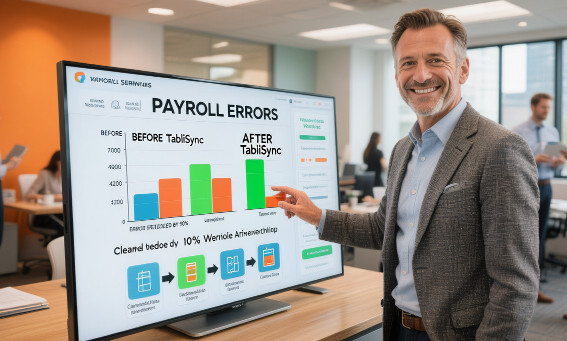
Result: This transformation was game-changing. The three-day manual process was reduced to a fully automated pipeline that ran and validated the entire dataset in 45 minutes. More importantly, the payroll error rate was slashed from over 4% to under 0.5% in the first cycle. This direct reduction in payment errors and the elimination of manual adjustments saved the company over $18,000 in operational costs and overpayments every single pay period. Employee morale improved as pay became consistent and accurate, and the risk of compliance issues was virtually eliminated. This case study clearly demonstrates that high-volume data requires high-precision AI data cleaning solutions to achieve both efficiency and vital compliance.
Frequently Asked Questions on How to Remove Duplicates Excel
Q1: I tried Excel's built-in tool but it missed duplicates. What happened?
This is extremely common. You are almost certainly facing data that looks identical but isn't. The leading cause is invisible characters, such as a trailing space. Excel’s `Remove Duplicates` function is an exact-match system. It treats a cell containing 'A ' and another cell with 'A' as two unique values. To fix this manually, you would need to run the `=TRIM()` and `=CLEAN()` functions on all affected columns, then copy the results and `Paste as Values` to truly standardise your data before you can use the built-in tool reliably. The automated AI data cleaning in **TabliSync** has this cleaning logic built-in; it standardizes all text data and can use fuzzy logic to catch semantically identical records that are not 100% exact in character, bypassing this entire issue.
Q2: Can I combine multiple columns to find true duplicates in TabliSync?
Yes, and this is a major strength. TabliSync’s rule editor allows you to define the composite key for uniqueness. This is essential for business logic. For example, if you are looking at inventory, a unique record isn't just a 'Product ID'; it's the combination of 'Product ID', 'Warehouse Location', and 'Condition'. You can select these three columns in TabliSync to create your unique identifier, and the de-duplication engine will only remove rows that have identical values in all three fields. This multi-key and multi-step validation ensures you are not just deleting data, but performing intelligent AI data cleaning to support industrial data processing. This degree of specificity is key to success in high-complexity applications.
Q3: Does TabliSync delete the original data? Is it safe to use?
This is a crucial question for Trust. TabliSync does **not** delete your original data. It works by creating a copy of your dataset and then applying the duplication rules to that copy within a dedicated pipeline. You define the logic, and you get a downloadable cleaned dataset as output. Your original source Excel file remains entirely untouched. We always recommend this as a best practice in data management. Furthermore, for a robust audit trail, TabliSync generates a detailed resolution report that shows exactly which duplicate rows were identified, which rule was applied, and how the final values were merged or selected, which is essential for compliance in areas requiring high financial data accuracy.
Q4: My Excel dataset has over 1 million rows. Can TabliSync handle it?
Absolutely. Performance at scale is a core value proposition of TabliSync, especially for industrial data processing. Traditional Excel functions will often become incredibly slow or even crash when dealing with data this size. The de-duplication process with an advanced counting formula would take hours. TabliSync’s de-duplication engine is designed from the ground up for big data. We process and Remove Duplicates Excel from millions of rows in minutes, not hours. This is done by leveraging cloud-based distributed computing resources to handle the complex computations in parallel. We regularly process datasets of 10-20 million rows for clients, ensuring speed and reliability that manual tools can’t touch.
Q5: Can I schedule my de-duplication task to run automatically?
Yes, and this is the best way to automate spreadsheet workflows. You can configure each TabliSync pipeline with a flexible schedule. You can set it to run on an hourly basis, a daily basis, a weekly basis, or on specific days and times of your choosing. Every time the pipeline runs, it will fetch the latest data from your source, automatically apply the AI data cleaning logic to Remove Duplicates Excel, and generate a new, clean output dataset. This ensures your downstream analysis or application is always working with the most current and error-free data, removing all manual effort from your data preparation lifecycle. It’s a foundational part of modern data operations.
Q6: Can TabliSync's AI identify duplicates that are spelled differently?
Yes. This is the difference between an exact-match system and AI data cleaning. TabliSync has an advanced **AI Fuzzy Matching** feature. It uses natural language processing (NLP) to compare records semantically. For example, it can confidently flag 'Inc.' versus 'Incorporated', or 'Street' versus 'St.', and even catch common spelling variations of a name (like 'Jon' versus 'John'). You can control the semantic similarity threshold. You are not just matching characters; you are matching meaning. This capability is absolutely game-changing for customer data (CRM) consolidation or when merging vendor lists from multiple legacy systems, directly leading to improvements in financial data accuracy. This intelligent matching is a core feature you should be using.
Q7: When a duplicate is found, which record does TabliSync keep?
You have full control over this. TabliSync does not make arbitrary decisions. In our de-duplication rule builder, you explicitly define the **Merge Logic** or **Resolution Rule**. You can create sophisticated multi-step rules. For instance, for a product database, you might create a rule: "Keep the record with the highest price", or for a general ledger, "Keep the record that was created last according to its transaction timestamp". This rules-based system ensures that the de-duplication process is both predictable and auditable, which is essential for financial data accuracy. This is far superior to manual deletion in Excel where you are making a case-by-case decision that is prone to error and offers no audit trail.
Q8: I have a unique situation where some data must be handled specifically. Can TabliSync help?
Yes. TabliSync is a powerful, flexible platform. We understand that not every de-duplication case is straightforward. You can create highly advanced rule configurations that go beyond a single component. For instance, you could use a 'Filter' component to split your data into two paths: one for standard de-duplication and one for a specialized, high-touch rule. You can also chain multiple de-duplication steps together to achieve extremely precise data cleansing. For highly complex industrial data processing, we can even create custom-built de-duplication logic tailored to your exact business needs through our professional services. This flexibility ensures we can solve almost any problem you encounter with large-scale data cleansing.
Q9: How do I know the de-duplication was successful?
We provide multiple layers of verification. Immediately upon completing a sync, you are presented with a de-duplication summary report. This report shows you exactly how many rows were input, how many total duplicates were found, and the final unique row count. Crucially, we also generate a **Resolution Report**. This report is a transactional log for every duplicate group. It shows the individual input rows, which one was selected as the winner, and why (e.g., "Kept based on newest 'Modified Date'" rule). This level of transparency is essential for validating the logic and provides a clear audit trail that is critical for corporate compliance, especially in areas with high financial data accuracy requirements. You have complete visibility and control.
Q10: Is my data safe on your platform? I have PII (Personally Identifiable Information).
Data security is our top priority. We build trust by implementing robust security measures. TabliSync is built with a security-first architecture. We use industry-standard encryption for all data at rest and in transit (SSL/TLS 1.2 and AES-256). For PII, we are SOC 2 Type II compliant, which is a key industry standard for data protection. We provide granular access control, enabling you to manage which users in your organization have access to specific pipelines and data. Furthermore, you can configure your pipelines to mask or even permanently redact sensitive fields (like full credit card numbers or social security numbers) within the de-duplication output, providing an additional layer of security and helping you maintain compliance with regulations like GDPR or CCPA. You can trust TabliSync with your most sensitive data.
Stop Battling Spreadsheets, Start Winning with Clean Data
Manually trying to **Remove Duplicates Excel** data is a massive waste of your most valuable resources. It's a slow, error-prone battle against invisible spaces, conflicting formats, and a simple lack of semantic understanding that is embedded into older tools. Relying on basic functions like `Remove Duplicates` is no longer viable for high-volume, high-integrity data. It’s an obsolete strategy that erodes profitability and increases compliance risk.
You need to transform your data processes now. Moving to **AI data cleaning** with **TabliSync** is not just an efficiency gain; it's a fundamental change in how your organization handles information. You are moving from a state of manual friction and high risk to one of automated flow and verified financial data accuracy. Reclaim the 300+ hours your team is currently wasting, close your month-end financial cycle 6 days faster, and cut your payroll errors in half. The results are clear and immediate.
Every minute you delay is a minute your competition is operating with cleaner, faster, and more reliable data. The pain of manual data management will not go away on its own; it will only grow with the size and complexity of your business. Don't let your valuable analysts continue to be data janitors. Empower them with intelligent, scalable solutions. Stop fighting a losing battle and start winning with clean, verified data that drives your business forward. We are ready to help you on this journey. This transformation is straightforward and the results are guaranteed. The choice is yours: stay stuck with manual tools or embrace the future of automated, intelligent data.
Experience the transformation for yourself today. This is the moment to act. **[Click here to start your free 3-day trial of TabliSync.]** Our platform requires no complex setup or extensive training. We will show you how to connect your first Excel file and achieve precise, AI-driven de-duplication in less than 30 minutes. The time savings you reclaim in your first week alone will more than pay for the entire year. Take control of your data and unlock the true potential of your organization.
All Remove Duplicates Excel Articles(2)

Mastering the Mess: How to Remove Duplicates in Excel Without Data Loss
Efficiency Gains: Reduce manual data scrubbing time by over 90% using automated workflows. Data Integrity: Achieve a 0% manual entry error rate by moving away from 'Find & Replace' to schema-based deduplication. Risk Mitigation: Prevent 100% of accidental deletions by utilizing non-destructive Power Query environments. Future-Proofing: Shift from reactive cleaning to proactive Data Hygiene through AI-integrated automation.

How to Unprotect an Excel Sheet Without Knowing the Password
• Instantly bypass Excel sheet protection with 0% data loss.• Reduce manual recovery time by 95% using XML schema manipulation.• Eliminate 'locked cell' errors and restore full data hygiene instantly.• Leverage AI OCR to transform static protected views into dynamic structured data.
Stop Manual Data Entry – Extract Tables in Seconds
Convert any image or PDF table to Excel instantly with 99.9% accuracy. TabliSync's AI-powered OCR handles handwritten forms, receipts, and complex tables – then syncs directly to Google Sheets, Notion, or Airtable
Try TabliSync Free Now